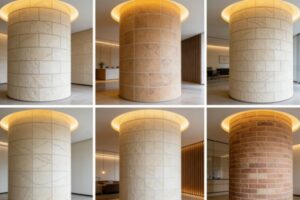
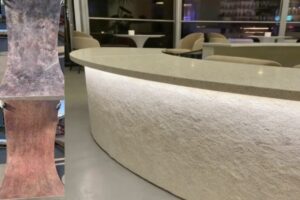
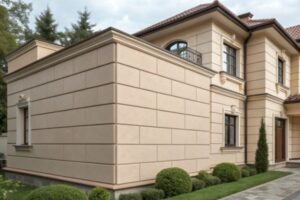
Stone + Stucco + Flexible Stone
A Modern Facade Solution for Commercial and Lightweight Renovation Projects
Stone and stucco have long been a classic combination in architectural design. From residential developments to commercial buildings, this pairing delivers a sense of permanence, texture, and architectural depth.
However, modern construction and renovation projects face new challenges:
structural load limitations1, accelerated timelines2, renovation over existing surfaces3, and tighter cost control4.
This is where Flexible Stone — also known as soft stone veneer — is redefining how stone and stucco facades are executed, especially for commercial, multi-family, and renovation-focused projects5.
This page explores how Stone + Stucco + Flexible Stone work together as a contemporary facade system designed for today’s building realities.
Why Stone and Stucco Remain a Timeless Facade Combination
Stone and stucco naturally complement each other:
- Stone provides texture, material depth, and a premium natural appearance
- Stucco offers clean surfaces, design flexibility, and visual balance
This combination is widely used in:
- Commercial buildings
- Hotels and hospitality projects
- Mixed-use developments
- Multi-family and residential complexes
Yet traditional stone systems often struggle to meet modern project constraints.
The Limitations of Traditional Stone in Today’s Projects
While full-depth natural stone delivers strong visual impact, it introduces practical challenges, particularly in large-scale or renovation projects:
- Heavy weight requiring structural reinforcement
- Wet installation with longer construction timelines
- High labor and scaffolding costs
- Poor compatibility with renovation over existing facades
- Limited feasibility for high-rise applications
In retrofit and lightweight renovation projects, these factors often make traditional stone impractical.
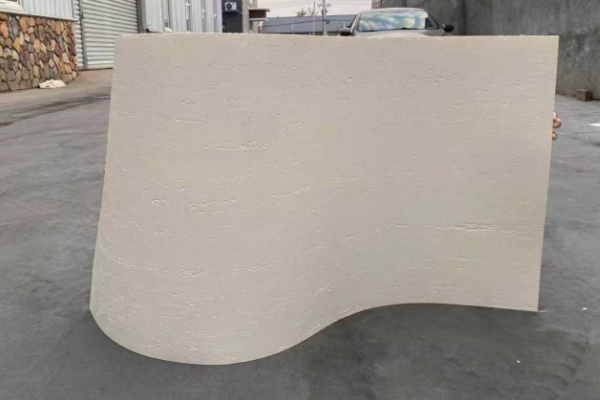
Flexible Stone: The Lightweight Evolution of Stone Facades
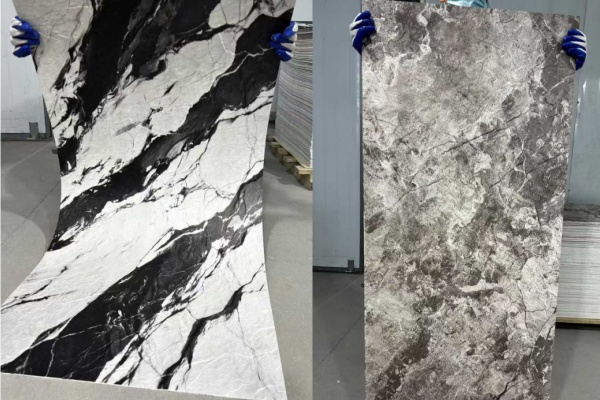
Flexible Stone preserves the visual appeal of natural stone while fundamentally transforming its physical properties.
What Is Flexible Stone?
Flexible stone is a next-generation architectural surface material made from natural stone powder combined with high-performance polymer composites6.
Key characteristics include:
- Ultra-thin profile (typically 1–3 mm)
- Over 70% lighter than traditional stone
- Flexible, cuttable, and adaptable to curved or irregular surfaces
Despite its lightweight structure, it retains the natural texture, color variation, and mineral depth of real stone.
This makes flexible stone an ideal material within modern stone + stucco facade systems.
7 Practical Applications of Stone + Stucco + Flexible Stone
1. Stone Accents on Stucco Facades Without Structural Reinforcement
Introduce stone aesthetics to stucco facades without increasing structural load:
- Building entrances
- Window surrounds
- Vertical architectural bands
Ideal for commercial storefronts, office buildings, and urban renovation projects.
2. Durable Stone Base and Wainscot Systems
Lower facade areas face greater wear and impact.
Flexible stone provides a durable and visually refined solution for:
- Building bases
- Wainscot areas
- Ground-level facades
It installs directly over concrete, masonry, or existing stucco without heavy backing systems.
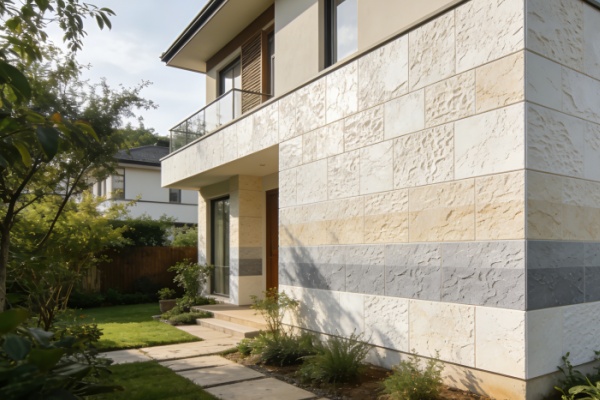
3. Renovation Over Existing Stucco or Tile
One of flexible stone’s biggest advantages is its ability to install directly over existing surfaces, including:
- Aged stucco
- Concrete walls
- Ceramic or cement tiles
This significantly reduces demolition, dust, downtime, and disruption — critical for hotels, retail centers, and occupied buildings.
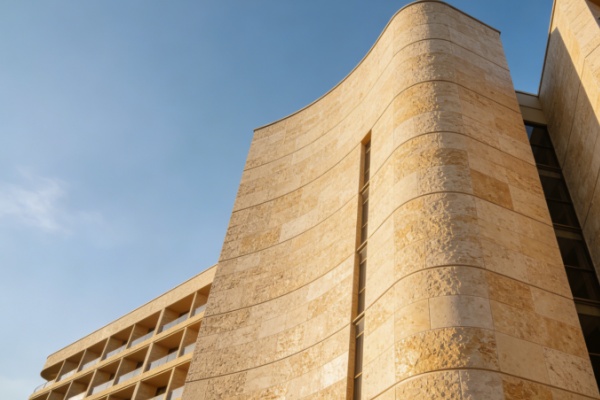
4. Curved and Architectural Feature Surfaces
Traditional stone struggles with curvature. Flexible stone excels in:
- Columns and pillars
- Curved walls
- Complex architectural forms
This opens new design possibilities for architects and designers.
5. High-Rise and Lightweight Facade Systems
Facade weight directly impacts project cost and engineering requirements in high-rise buildings.
Flexible stone enables:
- Stone-look facades at elevation
- Reduced anchoring and substructure
- Compatibility with modern curtain wall and insulation systems
6. Fast-Track Commercial Construction
Flexible stone is typically installed using dry or adhesive-based systems, allowing for:
- Faster installation cycles
- Reduced labor intensity
- Minimal weather dependency
Well suited for commercial chains, hospitality projects, and export-driven developments.
7. Sustainable and Export-Oriented Projects
Flexible stone supports sustainability goals through:
- Reduced raw material usage
- Lower transportation emissions
- Minimal construction waste
Its lightweight nature also significantly lowers international shipping and handling costs, making it ideal for global B2B supply.
Stone vs Stucco vs Flexible Stone: A Practical Comparison
| Feature | Traditional Stone | Stucco | Flexible Stone |
|---|---|---|---|
| Weight | Heavy | Light | Ultra-light |
| Thickness | 30–50 mm | 10–20 mm | 1–3 mm |
| Installation | Wet system | Wet system | Dry / Adhesive |
| Renovation friendly | Low | Medium | High |
| Curved surfaces | No | Limited | Yes |
| Commercial scalability | Medium | High | Very High |
When Should Flexible Stone Be Specified?
Flexible stone is particularly suitable when projects involve:
- Structural load limitations
- Tight construction schedules
- Renovation without demolition
- Curved or irregular surfaces
- Repetitive or large-scale developments
It does not replace all traditional stone applications but dramatically expands where stone aesthetics can be applied.
The Future of Stone + Stucco Facade Design
Modern facade design is no longer a choice between aesthetics and feasibility.
By integrating flexible stone into stone and stucco systems, developers and designers achieve:
- Greater design freedom
- Faster construction timelines
- Lower structural and logistical constraints
For commercial and renovation-focused projects, lightweight stone solutions are becoming the new standard.
Conclusion
Stone and stucco remain timeless architectural materials — but their execution is evolving.
By incorporating Flexible Stone (soft stone veneer) into stone + stucco facade systems, commercial and renovation projects gain:
- Authentic stone appearance
- Improved installation efficiency
- Reduced structural and cost pressures
The future of facade design is not heavier — it is lighter, smarter, and more adaptable.
Understanding structural load limitations helps in selecting materials that won't compromise building integrity, especially in renovation projects. ↩
Exploring accelerated timelines can reveal strategies to meet tight deadlines without sacrificing quality, crucial for modern construction. ↩
Understanding renovation techniques can minimize disruption and cost, especially in occupied buildings. ↩
Learning about cost control methods can help manage budgets effectively, ensuring projects stay financially viable. ↩
Understanding these challenges can guide better planning and execution of diverse construction projects. ↩
Learning about these composites can highlight their advantages in enhancing material properties for construction. ↩