How to Update a Stone Fireplace Without Demolition
Lightweight Fireplace Renovation Solutions for Commercial & B2B Projects
Renovating an outdated stone fireplace no longer means heavy demolition, long downtime, or structural reinforcement. For commercial spaces, hospitality projects, multi-family developments, and renovation contractors, lightweight fireplace renovation materials1 are transforming how stone fireplaces are updated—faster, cleaner, and more cost-effectively than traditional stone systems.
This guide explores modern stone fireplace renovation solutions with a focus on flexible stone (soft ceramic / flexible stone veneer)—a next-generation material engineered for large-scale and professional applications.
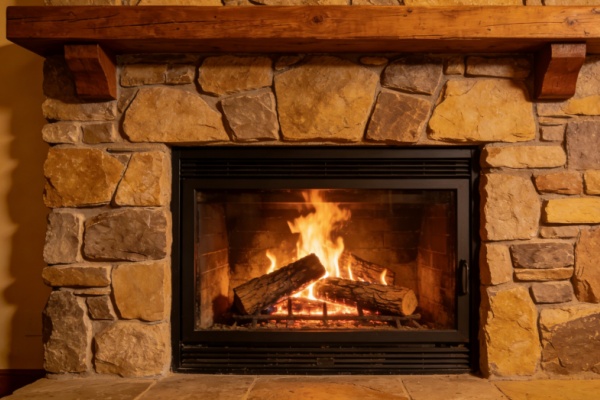
Why Traditional Stone Fireplace Renovation Is No Longer Ideal for B2B Projects
Conventional stone and thick stone veneer systems were designed for new builds, not fast renovations. In real-world commercial projects, they introduce multiple challenges:
- Excessive weight2 that may exceed existing wall load limits
- Demolition requirements3 that increase labor, dust, and downtime
- Complex installation needing skilled masonry teams
- Long project timelines that disrupt operations
For hotels, offices, retail spaces, and residential developers, these issues directly impact cost, scheduling, and ROI.
The Shift Toward Lightweight Stone Fireplace Renovation
Modern renovation projects demand materials that are:
- Lightweight
- Thin-profile
- Easy to install over existing surfaces
- Suitable for curved or irregular structures
- Visually indistinguishable from natural stone
This is where flexible stone (also known as soft ceramic stone) becomes a practical alternative.
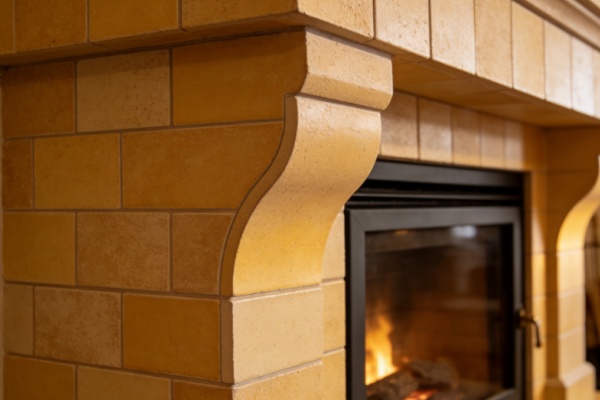
What Is Flexible Stone (Soft Ceramic Stone)?
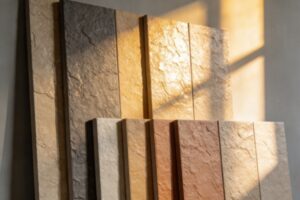
Flexible stone is an eco-friendly composite material made from natural stone powder combined with advanced polymer binders. It preserves the authentic texture, color variation, and mineral appearance of real stone—while eliminating the limitations of traditional masonry.
Key Material Characteristics
- Thickness: typically 1–3 mm
- Weight: over 70% lighter than traditional stone
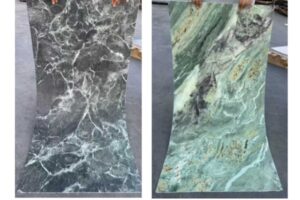
- Flexibility: can bend and conform to curved surfaces
- Cuttable: easily trimmed on site
- Surface compatibility: installs over tile, concrete, brick, drywall, metal panels
Unlike wallpaper or printed panels, flexible stone uses real stone content, delivering genuine depth and surface texture.
Why Flexible Stone Is Ideal for Fireplace Renovation Projects
1. No Demolition Required
Flexible stone can be installed directly over existing stone, brick, or tile fireplaces. This eliminates:
- Dust-heavy demolition
- Structural repairs
- Disposal costs
For operational commercial spaces, this is a major advantage.
2. Ultra-Lightweight for Structural Safety4
Fireplace surrounds are often load-sensitive, especially in older buildings. Flexible stone adds minimal weight, making it suitable for:
- High-rise buildings
- Retrofit projects
- Partition walls and non-load-bearing structures
3. Faster Installation = Lower Labor Cost
Compared with traditional stone systems, flexible stone reduces installation time significantly:
- No heavy lifting equipment
- Fewer installers required
- Simplified adhesive-based installation
This makes it highly attractive for contractors and developers managing multiple units or locations.
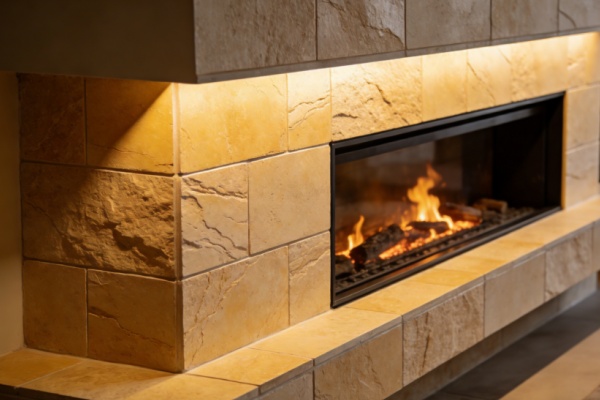
4. Suitable for Curved & Custom Fireplace Designs
Many modern fireplaces feature:
- Rounded corners
- Vertical curves
- Integrated architectural elements
Flexible stone naturally adapts to these forms—something rigid stone panels cannot achieve without extensive cutting and waste.
5. Fire-Resistant & Durable
When properly specified, flexible stone systems offer:
- Excellent heat resistance for fireplace surrounds
- Strong adhesion and surface durability
- Long-term color stability
This makes them suitable for both residential and commercial fireplace applications.
Flexible Stone vs Traditional Stone Veneer
| Feature | Traditional Stone Veneer | Flexible Stone |
|---|---|---|
| Weight | Heavy | Ultra-light |
| Thickness | 20–40 mm | 1–3 mm |
| Demolition required | Often | No |
| Curved surfaces | Difficult | Easy |
| Installation speed | Slow | Fast |
| Labor cost | High | Lower |
| Commercial scalability | Limited | High |
Typical B2B Applications
Flexible stone fireplace renovation solutions are widely used in:
- Hotels & resorts (lobby fireplaces, guest suites)
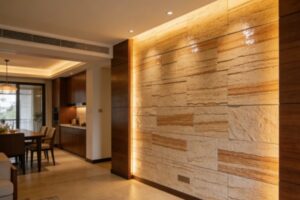
- Commercial offices (feature walls & lounge areas)
- Retail & hospitality spaces
- Multi-family residential developments
- Renovation & remodeling projects
- Prefabricated and modular buildings
For export markets, flexible stone is also ideal due to its lightweight logistics advantage, reducing shipping costs and breakage risks.
Design Flexibility Without Visual Compromise
Flexible stone finishes are available in a wide range of:
- Natural stone textures
- Contemporary and minimalist patterns
- Neutral and architectural color palettes
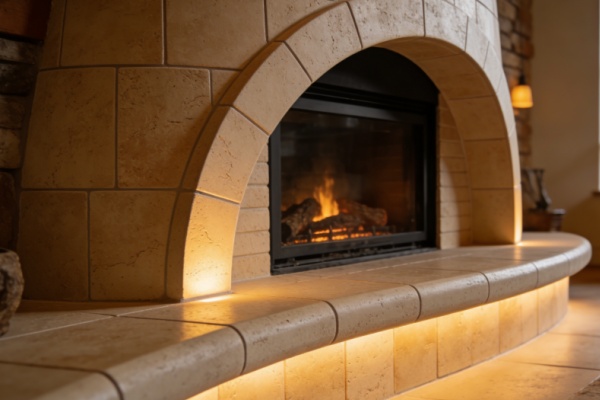
From modern linear fireplaces to classic stone surrounds, the final appearance remains authentic—without the engineering constraints of real stone blocks.
A Smarter Approach to Fireplace Renovation
For B2B buyers, architects, and contractors, updating a stone fireplace is no longer about choosing the heaviest or thickest material. It’s about selecting solutions that balance:
- Aesthetics
- Installation efficiency
- Structural safety
- Cost control
Flexible stone (soft ceramic stone) offers a forward-thinking approach—combining the beauty of natural stone with the performance modern projects demand.
Final Thoughts
As renovation cycles accelerate and commercial projects demand faster turnaround times, lightweight stone fireplace renovation materials are becoming the industry standard. Flexible stone allows professionals to modernize outdated fireplaces without demolition, structural reinforcement, or extended downtime.
For projects where efficiency matters as much as design, flexible stone provides a scalable, export-ready, and future-proof solution.
If you are sourcing flexible stone or soft ceramic materials for commercial or large-scale fireplace renovation projects, selecting a manufacturer with export experience and consistent quality control is essential.
Discover how lightweight materials can transform fireplace renovations, offering faster, cleaner, and cost-effective solutions for commercial projects. ↩
Understand the challenges posed by heavy stone materials in renovations, including structural load limits and increased labor costs. ↩
Explore the drawbacks of demolition in renovations, such as increased dust, downtime, and labor, and how flexible stone can eliminate these issues. ↩
Learn how flexible stone's minimal weight makes it ideal for load-sensitive structures, ensuring safety in high-rise and retrofit projects. ↩