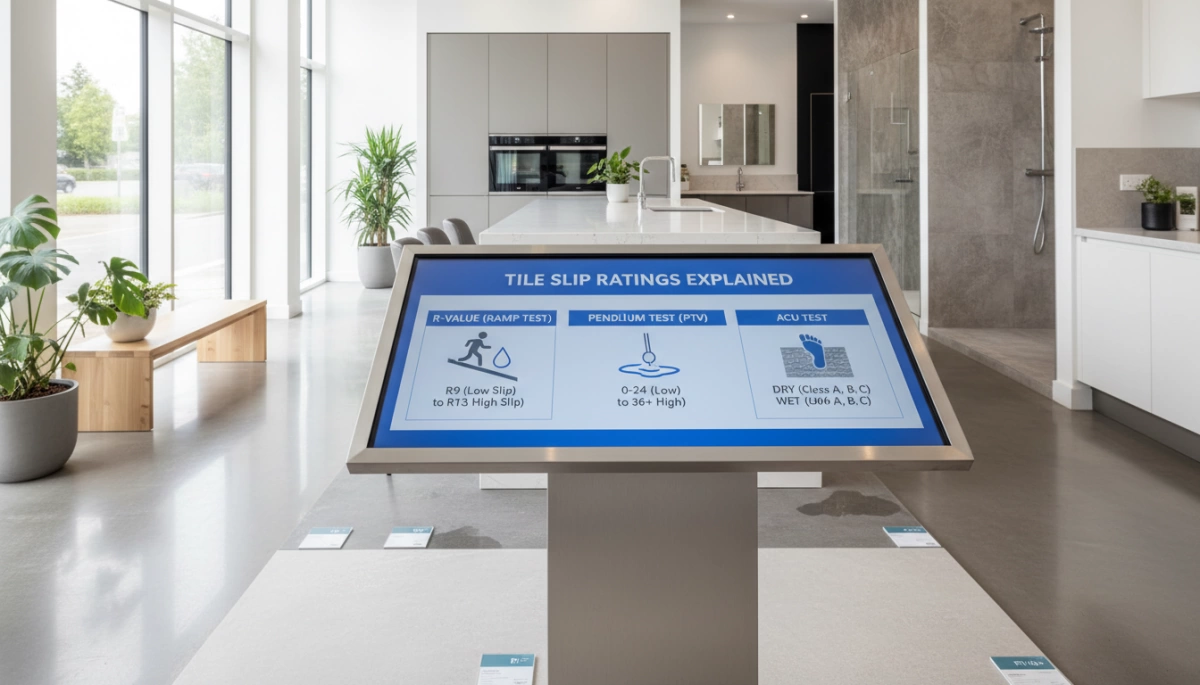
Are you struggling to figure out which floor tiles are actually safe for your next project?
Selecting the right surface can make a massive difference in preventing slips and keeping your space secure.
You might already know that manufacturers use confusing codes to grade safety…
But what do they mean, exactly?
Well, you’re in for a treat because I’ve put together a complete guide to get tile slip ratings explained.
In this post, you’re going to learn exactly how to decode the R rating system, the P rating system, and DCOF, step by step. I will give you practical advice that cuts through the jargon so you can confidently choose the perfect slip-resistant tile for residential kitchens, outdoor spaces, or high-traffic commercial areas.
So if you want to pick the safest floors without the guesswork, this guide is for you.
Let’s dive right in.
What Are Tile Slip Ratings?
Tile slip ratings are standardized scientific measurements used to determine the frictional resistance of a flooring surface. They provide a clear indicator of how much grip a specific tile offers under various environmental conditions. As a trusted porcelain floor tile manufacture and supplier, we engineer our surfaces to ensure that premium aesthetics never compromise functional safety. These ratings are essential tools that guide architects, contractors, and homeowners in selecting the perfect material for their specific project demands.
Why Slip Ratings Matter for Safety
Prioritizing floor tile safety is non-negotiable in both residential and commercial architecture. A proper slip rating actively prevents dangerous slip-and-fall accidents, ensuring spaces remain secure for continuous foot traffic.
Key reasons to prioritize accurate slip resistance include:
- Accident Prevention: High-traffic environments require maximum grip to protect building occupants.
- Environmental Adaptability: Flooring must perform flawlessly and maintain traction in both wet and dry conditions.
- Specialized Applications: Exterior spaces like patios and pool decks rely heavily on dedicated outdoor anti-slip tiles to combat rain, humidity, and standing water.
- Regulatory Compliance: Meeting stringent commercial building codes protects property owners from safety liabilities.
Understanding Coefficient of Friction (COF vs. DCOF)
The scientific foundation of evaluating slip resistance lies in the Coefficient of Friction. This metric calculates the mechanical resistance between an object—such as a shoe sole or a bare foot—and the tile surface.
- COF (Static Coefficient of Friction): This metric measures the force required to start moving from a completely stationary position. While historically significant, it is an older measurement primarily used to assess slip resistance on purely dry surfaces.
- DCOF (Dynamic Coefficient of Friction): This is the current, highly accurate industry standard. DCOF measures the frictional resistance when an object is already in motion across the tile. A standard DCOF rating of 0.42 or higher is the baseline requirement for indoor, level spaces that will be walked upon when wet. It serves as the ultimate benchmark for modern floor tile safety.
The ‘R’ Rating System Explained (Ramp Test)
The ‘R’ rating system is one of the most widely recognized standards for measuring slip resistance. To determine this rating, testers use the Ramp Test. A person wearing standardized footwear stands on a tile surface covered in oil. The ramp is slowly tilted upward until the person slips. The angle at which the slip occurs determines the ‘R’ value. Because we are a porcelain floor tile manufacture and supplier, we constantly test our products this way to ensure maximum floor tile safety for our global clients. The higher the ‘R’ number, the steeper the angle achieved, which means better grip.
R9 and R10 Ratings: General Indoor Use
Tiles graded R9 and R10 are your go-to choices for standard residential settings.
- R9 Tiles: These have the lowest friction level in the ‘R’ scale. They are perfectly safe for dry indoor spaces like living rooms, dining rooms, and bedrooms.
- R10 Tiles: These provide a slight step up in friction. They handle occasional moisture well, making them ideal for domestic kitchens, hallways, and standard bathrooms.
Both ratings offer excellent functionality and are very easy to clean while maintaining essential safety in standard dry conditions.
R11, R12, and R13 Ratings: Wet and Outdoor Areas
When you move into environments that face constant moisture or steep inclines, you need heavy-duty slip resistance.
- R11: This is the baseline for safe outdoor anti-slip tiles. We highly recommend R11 for patios, mudrooms, and residential wet rooms. It offers a secure grip in both wet and dry conditions without being overly difficult to clean.
- R12: Designed for more demanding environments. R12 tiles are excellent for commercial kitchens, public restrooms, and sloped outdoor walkways where water pooling is common.
- R13: This is the highest slip resistance rating available. R13 tiles feature a highly textured surface. They are strictly meant for extreme industrial settings, public swimming pool edges, or commercial food processing plants where heavy grease and water are constantly present.
The ‘P’ Rating System Explained (Pendulum Test)
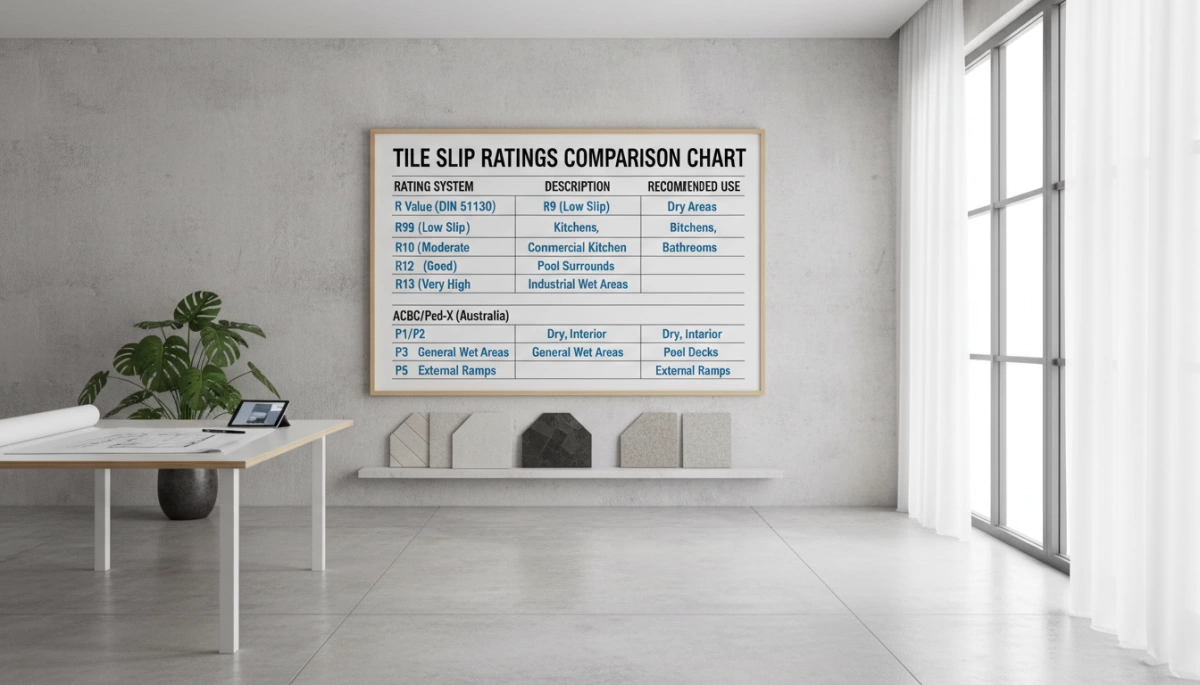
As a porcelain floor tile manufacturer and supplier, we rely on the Pendulum Test to guarantee floor tile safety across different environments. This test simulates a standard shoe heel striking the floor, measuring the friction to provide an accurate slip resistance score for both wet and dry conditions. The results are categorized from P0 up to P5.
P0 to P2 Ratings: Low Slip Resistance
Tiles falling into the lower end of the pendulum scale are generally smoother and designed for dry environments.
- P0 to P1: These tiles offer very little friction. They are strictly for dry indoor areas like living rooms or bedrooms where moisture is not a concern.
- P2: This rating provides a very slight grip. While a bit safer, P2 tiles should still be kept to indoor spaces with minimal water exposure.
P3 to P5 Ratings: Moderate to High Slip Resistance
When dealing with moisture, moderate to high slip resistance is strictly required to prevent accidents.
- P3: This is the standard rating for residential wet areas. P3 tiles offer enough grip for bathroom floors, kitchens, and laundry rooms.
- P4: Providing high friction, P4 tiles are the go-to choice for commercial spaces, entryways, and covered outdoor patios.
- P5: This is the highest level of grip available. P5 ratings represent heavy-duty outdoor anti-slip tiles, perfectly suited for uncovered pool decks, steep ramps, and public walkways exposed to constant weather elements.
The Barefoot Wet Ramp Test Explained
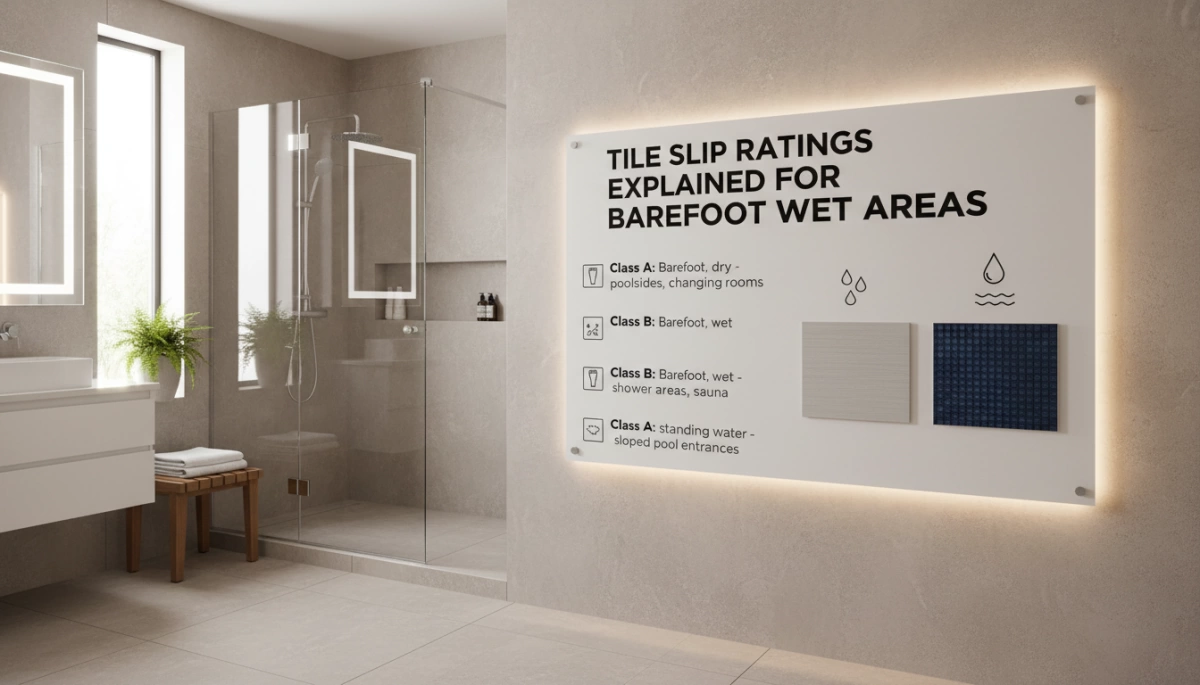
When evaluating floor tile safety, especially in areas where people walk without shoes, the Barefoot Wet Ramp Test is crucial. Testers walk barefoot on an inclined, soapy, and wet tile surface to measure exactly when slipping occurs. Because we are a porcelain floor tile manufacture and supplier, we rely heavily on this standardized testing to ensure our tiles perform reliably across various wet and dry conditions. The results from this test categorize tiles into three simple grades: Class A, B, and C.
Class A Ratings: Dry Areas
Class A tiles provide a baseline level of slip resistance for barefoot traffic. They are designed for spaces that remain mostly dry but might occasionally see minor moisture.
- Best Applications: Indoor dry zones, locker rooms, and standard barefoot walkways.
- Safety Threshold: Safely grips bare feet on inclines up to 12 degrees.
- Performance: Reliable for everyday foot traffic away from direct, heavy water sources.
Class B and C Ratings: Pools and Showers
When dealing with constant moisture and standing water, you need aggressive slip resistance. Class B and C ratings are non-negotiable for maintaining safety in consistently wet environments.
- Class B (Moderate to High Grip): Perfect for public showers, pool surrounds, and shallow pool steps. These tiles safely handle inclines up to 18 degrees.
- Class C (Maximum Grip): Built for the highest-risk zones. This rating is required for sloped pool edges, walk-through pools, and fully submerged stairs, handling inclines of 24 degrees or more.
- Outdoor Use: If you are sourcing outdoor anti-slip tiles for a commercial swimming pool facility, Class C ensures the highest level of accident prevention.
How to Choose the Right Slip Rating by Area
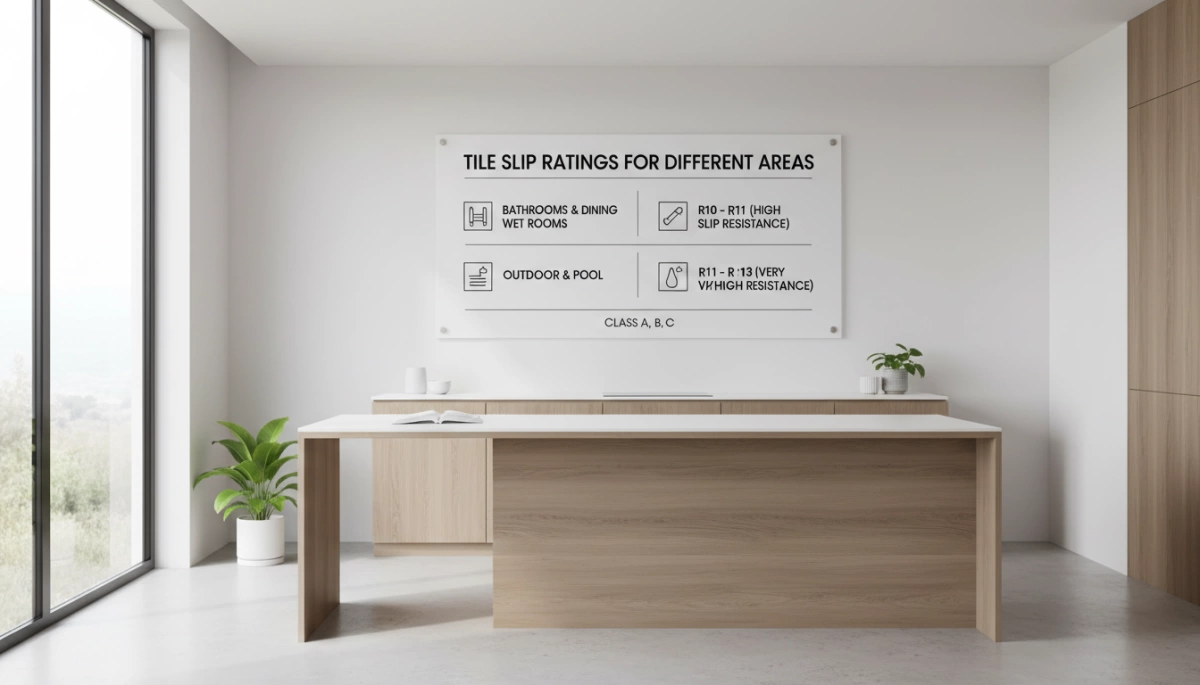
As a porcelain floor tile manufacture and supplier, we know that picking the right tile goes beyond just aesthetics. You need the correct slip resistance for specific zones to ensure floor tile safety. Matching the tile to the environment prevents accidents in both wet and dry conditions.
Here is a quick reference guide to help you choose the right rating for your space:
| Area Type | Recommended R-Rating | Recommended P-Rating | Key Focus |
|---|---|---|---|
| Indoor Living/Dining | R9 | P1 – P2 | Easy cleaning, minimal moisture |
| Kitchens & Bathrooms | R10 | P3 | Moderate spill risk, daily moisture |
| Outdoor Patios & Pools | R11 – R13 | P4 – P5 | Heavy rain, standing water, barefoot safety |
| Commercial Kitchens | R12 – R13 | P4 – P5 | Grease, heavy spills, constant foot traffic |
Residential Kitchens and Bathrooms
Inside the home, kitchens and bathrooms are the prime spots for slips. Water splashes from the sink, condensation from showers, and dropped food create slippery surfaces.
- Kitchens: An R9 or R10 (or P2 to P3) rating is perfect. It provides enough grip for daily spills while remaining easy to mop clean.
- Bathrooms: Because barefoot safety is crucial here, step it up to an R10 or a P3 rating. If you are tiling directly inside a walk-in shower, look for tiles specifically rated for barefoot wet areas (Class B or C).
Entryways, Mudrooms, and Outdoor Spaces
When transitioning from the outside in, your floors take a beating from rain, mud, and snow.
- Entryways & Mudrooms: Use an R10 or R11 tile. This grips well against wet shoes tracking in debris.
- Outdoors: For patios, walkways, and pool decks, you absolutely need dedicated outdoor anti-slip tiles. Always choose R11, R12, or R13 (P4 to P5). These highly textured surfaces guarantee solid traction in severe wet and dry conditions.
Commercial and High-Traffic Settings
Commercial environments face strict safety standards due to heavy, constant use by the public. Floor tile safety is non-negotiable here to prevent liability and ensure customer safety.
- Lobbies and Retail Stores: An R10 or P3 rating handles general, dry foot traffic perfectly.
- Public Restrooms and Supermarkets: Opt for R11 or P4 to manage frequent wet-mopping and spills safely.
- Commercial Kitchens and Industrial Zones: You need maximum slip resistance. Go straight for R12 or R13 (P5) to combat oil, grease, and industrial wash-downs.
Tips for Maintaining Slip-Resistant Tile Floors
As a porcelain floor tile manufacture and supplier, we know that installing the right tile is only half the battle. Keeping those floors safe requires a bit of ongoing attention to ensure the slip rating holds up over time.
Choosing the Right Tile Finishes (Matte vs. Textured)
The finish you pick directly impacts long-term floor tile safety and how easy the floor is to maintain.
- Matte Finishes: These are ideal for indoor areas like kitchens and hallways. They offer excellent slip resistance without deep grooves, making them incredibly easy to sweep and mop daily.
- Textured Finishes: These are essential for outdoor anti-slip tiles, pool decks, and commercial showers. The physical grooves grip shoes and bare feet, providing maximum safety in both wet and dry conditions. Just keep in mind that deeper textures can trap dirt, requiring a bit more effort to keep clean.
Proper Cleaning and Maintenance Practices
Dirt, grease, soap scum, and the wrong cleaning chemicals can completely ruin a tile’s natural slip resistance. Here is how to maintain maximum traction year-round:
- Sweep regularly: Remove loose dust, sand, and debris. Left on the floor, these particles act like tiny ball bearings underfoot.
- Use the right cleaner: Stick to pH-neutral tile cleaners. Strictly avoid wax-based, oil-based, or high-gloss soaps, as these leave a dangerous, slippery residue across the surface.
- Scrub textured tiles: For heavily textured or outdoor tiles, use a soft-bristle deck brush. A standard mop will simply glide over the surface, but a brush will actually dislodge the grime trapped in the anti-slip grooves.
- Dry thoroughly: Never leave standing water after mopping. Squeegee or towel-dry the floor to restore its natural grip immediately.
